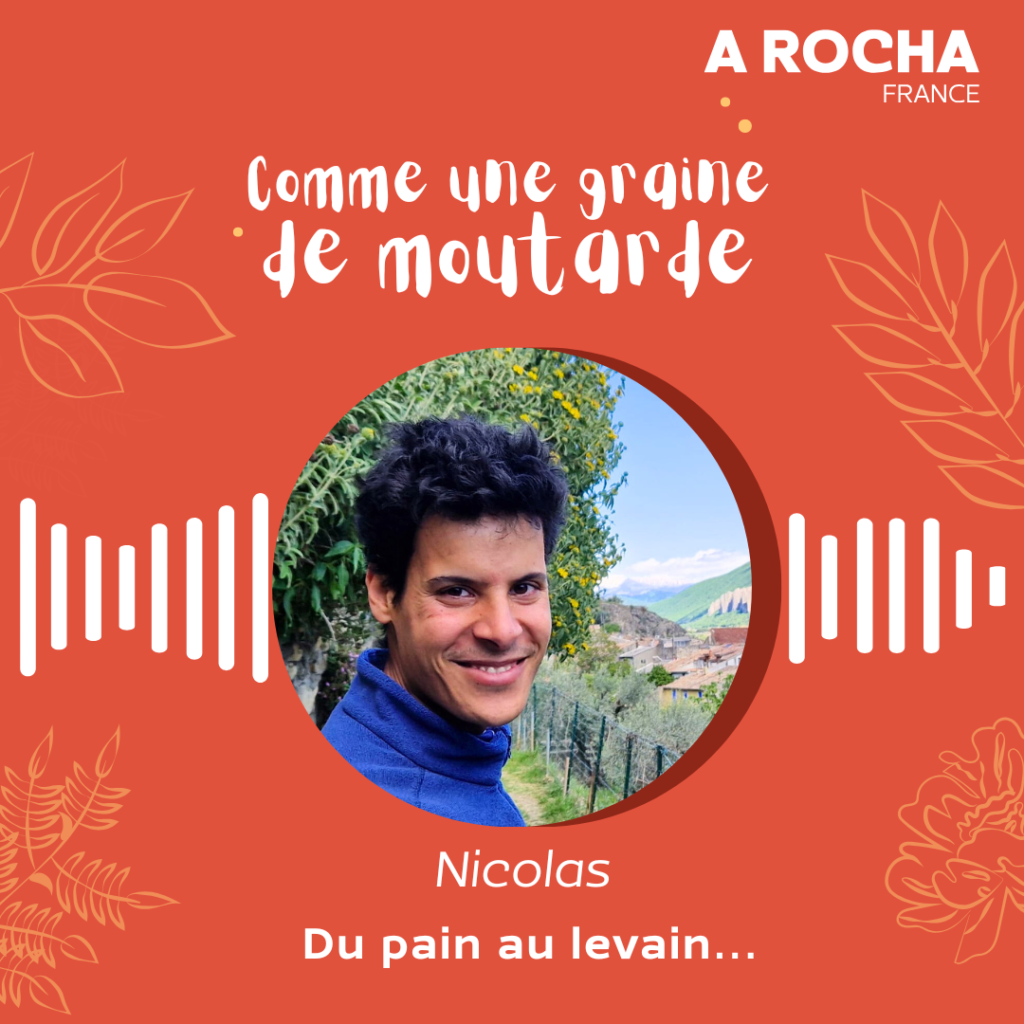
In this episode, Yoanna chats with Nicolas, A Rocha Ambassador and baker, who talks about the links between his work, his faith and his ecological commitment… with his sourdough bread!
With Comme une graine de moutarde (Like a Mustard Seed), come and find ideas for taking action to preserve life.
Like a mustard seed is available at:
Sourdough bread: read the transcript of the episode
Yoanna: There is a way for you to get involved in caring for creation that is particularly close to your heart, and it's related to your work as a baker. Can you tell us more about it?
Nicolas: Yes, absolutely! I’ve been baking bread, delivering it and selling it in a bakery for four years now. We’re a team of three artisan bakers. We’re based in a Provençal village with a population of 400. And each of us has to get our hands dirty, yes, but we also have to drive and work the till.
What makes my bakery business unique is that I make organic sourdough bread. Put like that, it doesn’t sound like a big deal. But it was this organic sourdough bread that encouraged me to follow this career path with God’s help.
Organic to preserve our soil and local cereal crops, sourdough to preserve the taste and quality of what I produce for the benefit of my fellow human beings.
Yoanna: You just mentioned your faith. What connection do you see between your job and your Christian faith?
Nicolas: The decision to become an organic artisan baker was not made by chance. I followed in the footsteps of my biological father, who was a conventional artisan baker in the same area where I live, in the Alpes d’Haute-Provence. But it was the word of God that led me to take this ethical and professional step. At the time, I had no idea that returning to the source of my food would have such a healthy influence on my daily life.
For example, today, when I get up at 4 a.m., which doesn’t happen every day, rest assured, I am aware that through my work, I am an ambassador for Jesus Christ at the bakery and at the market. And the advantage is that I can be an ambassador both to reconcile humans with their creator and to reconcile humans with God’s creation.
In my daily life, and even more so during the festive season when our consumption choices are important, my mind is constantly questioning me about taste, local produce, breastfeeding, etc.
Yoanna: But then, your customers have a special awareness of how this bread is made, the care that goes into the raw ingredients, the choice of sourdough bread, etc.
Nicolas: Yes, absolutely. We have customers who are very aware of organic products. That’s one of the main reasons they come to us. What’s more, the bread and other products we make are high quality. They are made from locally sourced ingredients from the Provence-Alpes-Côte d’Azur region.
More specifically, we have customers who come looking for quite unusual breads, such as Petite Épeautre bread or Zeck Kornbrot, a German bread that is rarely made in the Alpes d’Haute-Provence and the PACA region.
This attracts people who are interested in the diversity of the products we offer, but who are also environmentally conscious and interested in what we produce.
Yoanna: Great. So, we're on the podcast like a mustard seed, and generally speaking, mustard doesn't leave you indifferent. Are there things in your work that make you sneeze, that sting a little too much, or that simply give you enough flavour?
Yes, the first thing I can tell you is that my professional activity brings enough flavour and diversity to those who order these varieties of bread from us. And for my part, I feel useful both to my neighbour, to creation and to my creator through my work.
Even if my team is not yet interested in what I experience through my faith, it is not impossible to talk about my faith when I sell my bread at the Manosque market. It is also an opportunity to bear witness as a Christian who is responsible for all that God has created that is very good.
On the other hand, there is a limitation that makes me question my work as a baker. It is the amount of electrical energy or fuel we need to bake our bread. It is true that we work with an electric oven, which is convenient to use. But seeing the scarcity of fossil fuels and the increase in their costs, I wonder a lot about alternative energy sources and their efficiency.
Solar and wood are two such possibilities. But would we be prepared to adapt our lifestyles accordingly? Because with solar energy, bread has to be baked during the day and not necessarily at night. This is something that middle-class people rarely do nowadays.
Could we also bake bread for billions of men and women using the sun?
Would we be able to manage the biomass-producing areas of the planet that God has entrusted to us effectively and harmoniously? These are questions that sting a little, if not for the occasional bit of flour dust in the air that makes me sneeze.
Yoanna: Okay. Yes, indeed. It’s particularly poignant in France, where we are big bread lovers. So yes, it would be difficult to do without it.
Nicolas: So we absolutely must find solutions.
Yoanna: Thank you very much, Nicolas, for your testimony. See you soon. My pleasure, see you soon.