
Flying, travelling thousands of kilometres, crossing seas, oceans and continents, taking advantage of currents and winds – this is a good strategy for avoiding the cold: escaping winter. This technique, known as migration, is used by some insects in winter. The best known are monarch butterflies and globetrotting dragonflies, capable of travelling thousands of kilometres without stopping. However, these majestic insects represent only a small percentage of migrants, as the vast majority belong to the order Diptera (certain flies, midges, hoverflies, etc.).

These insects leave to avoid the drop in temperatures that would be fatal to them, but what happens to the insects that do not leave? In fact, only a small proportion of insects migrate (estimated at 5%), while all the others remain where they are and have to develop other strategies to cope with and survive the cold outside. But if not all insects have gone off to bask in warmer climes, how can we explain their absence? Where have the inhabitants of our gardens and forests gone, so ever-present, buzzing and even exasperating in warm weather?
Here are some techniques that insects have developed to get through the winter season.
I. A little pampering break
Winter is coming, and with it the low sun, short days and cold weather. This weather makes us want to curl up by the stove with a good book or watch a film with a cup of hot chocolate. At this time of year, some large mammals hibernate deep in their caves or dens to wait out the cold weather. Some of our tiny insects use almost the same strategy!
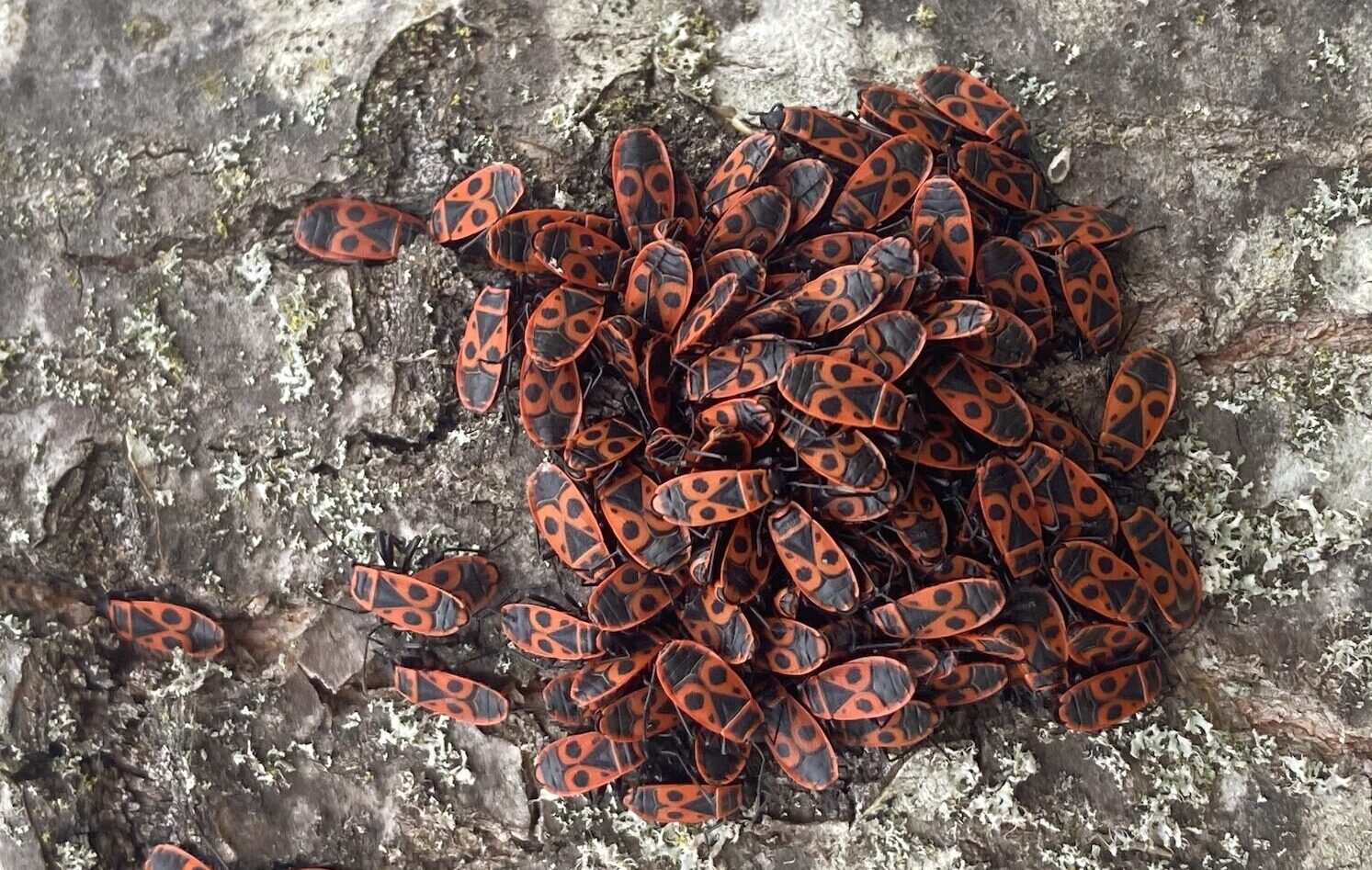
Insects are cold-blooded (known as ectotherms), they do not produce heat and are therefore greatly affected by the outside temperature. When the temperature drops, some insects slow down their lifestyle, activities and even their metabolism in order to survive. This is known as “diapause”. During this period, they are either very slow or immobile, they eat almost nothing, breathe very little, and do not develop any further in order to minimise their energy expenditure.
Slowing down is good for conserving energy, but it is important to ensure that you are safe and warm. In winter, these insects seek out confined spaces (under stones, dead leaves, stumps, underground, etc.) to protect themselves from predators and the cold outside. Just as we carefully close doors in winter to avoid even the slightest draught, insects seek out the most insulated places possible. Once they have found their winter home, they will not move again, trying to survive until the next season. Well sheltered, they are not bothered by the freezing cold or snow. Contrary to what one might think, snow helps to create an insulated habitat. By covering the ground, it protects against bad weather and reduces temperature variations.
But not all insects go to this trouble; some clever ones prefer to take advantage of the warmth of our homes rather than face the outside world. This strategy is called synanthropy, and is used by various insects throughout the year. But this method is not without risk, as these little creatures are not always welcome in our homes.
II. My son, my battle

Although diapause and synanthropy are practised by a large number of insects, most species adopt another strategy to perpetuate their genes: the next generation.
In spring, adult insects (known as imagoes) mate and lay their eggs to ensure their offspring. Once their mission is accomplished, they continue their existence until the first frosts, which they do not survive. It is therefore normal, once autumn has set in, to no longer be able to admire all the beautiful insects that used to roam our gardens. However, this does not mean that all insects have disappeared… That would be far too sad! They are simply present in other forms and less visible to our eyes.
Before reaching the imago stage that we are familiar with (butterfly, bee, beetle, etc.), all insects go through different stages of development: egg, larva and sometimes chrysalis. It is in these stages that most insects spend the winter.
If they manage to survive where their parents failed, it is because their bodies are more resistant in these stages of development and they have been placed in a warm, sheltered environment.
Their shelters can be found outdoors, such as mantis eggs (grouped together in a formation called an ootheca) in tufts of grass, or, if we broaden our scope to include other categories besides insects, spider cocoons in corners of huts or between stored logs.
But most prefer to hide their offspring underground, where they will develop and spend most of their lives. Until they emerge the following spring (or much later), reproduce, lay eggs, and die of cold in turn, entrusting the fate and future of their species to the next generation.
III. Some rather unusual insects in winter
We have presented the four main techniques used by insects to survive the winter season (migration, diapause, synanthropy, survival through juveniles). But with 1.3 million species described, the insect order is the most diverse in the animal kingdom. Behaviour therefore varies greatly between species, and there are many exceptions and secret techniques for survival. We will present a few examples of insects from the order Hymenoptera that do things differently from others.
The Queen is dead, long live the Queen
In many social insects that live in hives (hymenoptera), such as certain bumblebees, wasps and hornets, there is a combination of diapause and survival by juveniles. Hives cannot withstand the first cold spells of winter and the individuals succumb. Only the future queens survive, taking refuge in an isolated place where they enter diapause. In early spring, they emerge from their hiding places to found their own colonies.
Bee active

The honeybee (Apis Mellifera) has a special status among insects because it no longer lives in the wild. Beehives are created and maintained by humans, and food is provided to help the insects survive the winter. But beyond this difference, bees take action to survive the cold season. They gather in clusters, huddle together around the queen and contract certain muscles in their thorax. This movement generates heat and maintains a temperature of 20°C in the centre of the hive, even when the outside temperature reaches -10°C. The bees are highly organised in maintaining this heat and often change position to prevent those on the edges from freezing to death.
Look at the ant, you lazybones! See how it behaves and you will become wise.
Ants are an exception among social insects of the Hymenoptera order. Unlike bees, wasps, hornets, or bumblebees, ants manage to survive the winter as a community in their anthill. Thanks to their complex and efficient social organisation, they stockpile food to avoid finding themselves severely deprived when the cold weather arrives. Once these reserves are made, they burrow deep into the anthill and enter diapause to limit their consumption and energy expenditure. During this period, the ant queen stops laying eggs.
The indomitable bumblebee
As we explained at the beginning, all insects are ectothermic… All of them? No! Because one stubborn insect still resists the cold outside.
Unlike other insects, bumblebees have an endothermic metabolism, which means they produce their own heat. They are therefore less affected by the outside temperature. To do this, they contract their thoracic muscles by vibrating their wings. This movement allows them to heat their bodies above the outside temperature. Their long hairs also have an insulating effect and their black colour captures and absorbs heat. Thanks to this metabolism, bumblebees have a different life cycle from other insects. Worker bees remain active longer in autumn, and queens begin their diapause later and emerge earlier.
Insects are everywhere around us. They are there in summer, buzzing in our ears, climbing on our legs or in our picnics. But above all, they are everywhere we don’t take the time to look for them. On every blade of grass, in tree stumps, in trees, underground, at the bottom of a pond. They have adapted in different ways to all the spaces around us and are essential links in the cycle of life. So it’s a good thing they don’t all disappear during the cold season. In winter, insects are simply a little further underground, a little quieter, a little more isolated. They retreat to survive the cold of winter and return better prepared for the warmer season, accompanying the birdsong and the blossoming of buds.

Are you interested in the lives of small creatures? Discover our article on millipedes and pearls.

To support our awareness-raising projects, scientific monitoring and conservation actions, please make a donation to A Rocha!