An emblematic species of the Mediterranean region
The European Roller Coracias garrulus is one of Europe’s most charismatic birds. Its azure turquoise plumage makes it one of the most colourful birds on our continent. A highly migratory bird, it crosses the Sahara and the Mediterranean from southern Africa every year to nest and raise its young on our continent, a feat of over 6,000 km. From May onwards, it settles in the warmest regions, primarily around the Mediterranean, but also in Central and Eastern Europe, where the continental summer climate provides it with sufficient heat – and therefore food – to breed. It measures around thirty centimetres long with a wingspan of 70 centimetres, the size of a small corvid. From a dead branch, an electric wire or a post, it hunts large insects such as grasshoppers, cicadas and beetles.
A threatened species on a European scale
Once very abundant, the European roller is now threatened with extinction over a large part of its European range. In central and northern Europe, it has disappeared from Scandinavia, Germany, the Czech Republic, Slovakia, Slovenia and Croatia in just a few decades, and there are now just a few dozen pairs in the Baltic States, Belarus and Poland. Its populations are declining by at least 20% across Europe, from east to west and north to south, with a few rare exceptions. It has been on the Red List of Threatened Species since the early 2000s, with ‘Near Threatened’ (NT) status. Protected at European level by the Birds Directive, its trade has also been banned worldwide by the Washington Convention (CITES) since 2014.
An indicator species for good farming practices
The roller is an excellent bioindicator of sustainable agriculture. It uses natural cavities dug by woodpeckers for nesting, and its presence therefore indicates the presence of old trees and hedges. Its need for large insects as food is incompatible with agriculture, which is too heavy on insecticides. Its use of wooded areas for nesting and open areas for hunting make it an indicator of agricultural mosaics. A charismatic species that is easy to spot, its presence is accompanied by that of many other threatened species that share the same ecological needs, such as the little owl, the hoopoe, the shrike magpie and many others.
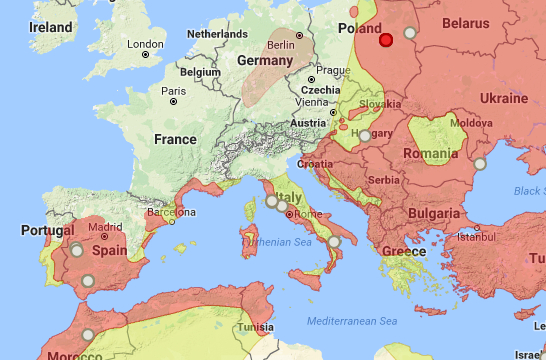
Distribution of the Roller in Western Europe
Red : nesting
Yellow : passage
(2011 – source : xeno-canto.org)
A Rocha France, recognised expertise in the Rollier
A Rocha France has been working to protect the European roller since 2002. We have set up a network of 50 nest boxes in one of the most important areas for the conservation of the European roller in France: the Vallée des Baux de Provence. The maintenance and monitoring of this network of nest boxes, along with other conservation measures (planting of hedges, installation of perches, etc.), have helped to increase the Roller population in this area, while the population continued to decline elsewhere in Europe.
We are also contributing to a number of other conservation projects for the Roller in the south of France:
– installation and monitoring of 72 nesting boxes and planting of 6 km of hedges on the Alpilles massif as part of the Alpilles LIFE programme since 2015,
– monitoring the network of nest boxes maintained by the Groupe Ornithologique du Roussillon in the communes of Salses-le-Château, Rivesaltes and Saint Hippolyte from 2012 to 2021,
– monitoring the network of nesting boxes installed along the Canal du Midi from 2017 to 2021, etc.
We have thus been able to develop our knowledge of the ecology and protection of the roller. In addition, we have developed an expertise on the species that is now recognised at national level, thanks to the support of the Ministry of the Environment since 2010. At international level, by taking part in a number of colloquia and conferences, we have been able to co-draft the European action plan for the conservation of the Roller and to put forward a number of recommendations for the conservation of the species. At an international level, we have taken part in a number of symposia and conferences, co-drafted the European action plan for the conservation of the Roller and set up collaborations with a number of universities and laboratories.
Our project to help the Roller
On the strength of our experience and the results we have achieved in recent years, our aim is to develop our conservation actions across the entire range of the European roller in France, and to share our knowledge of good practice for the European roller with as many people as possible.
Our actions consist of :
– to implement conservation actions in favour of the European roller throughout its breeding range in France: installation of nest boxes, planting of hedges, promotion of change towards sustainable agricultural practices, etc;
– carry out scientific studies: monitoring and evaluation of conservation actions, study of the ecology of the species (demographic traits, use of space, factors in decline), population census, study of hedgerows and habitats favourable to the European roller on a large scale;
– to disseminate our results to all European and African partners involved in the conservation of the European roller and to the scientific community of nature conservation in the broadest sense: publication of posters and brochures in English, writing of scientific articles and books, participation in conferences and symposia.
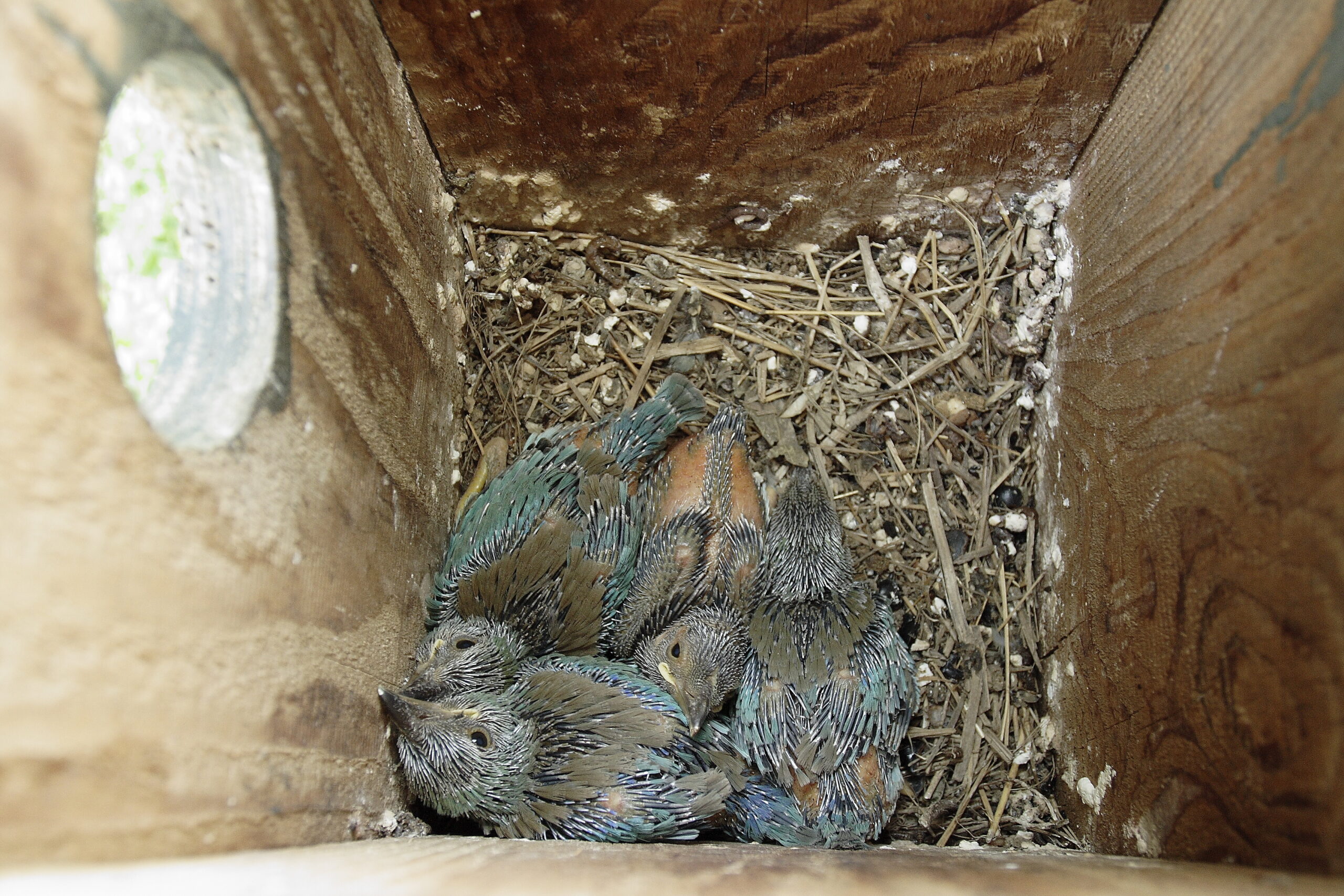
The inside of a nesting box
The roller does not build its own nest and uses natural cavities dug by woodpeckers, or artificial nest boxes as shown here. The disappearance of natural cavities is one of the main threats facing the roller.
Photo : © Orbán Zoltán
Sharing research on the European Roller
Timothée Schwartz has published a number of scientific articles in peer-reviewed journals:
– in 2016: article published in Journal of Ornithology on the description of the migration of the European roller based on ring recovery (read the article) ;
– in 2018: article published in IBIS (International Journal of Avian Science) on the specific conservation method of the cavity-nesting European roller (read the article);
– in 2020: article published in the journal Bird Study on the subject of changes in the species’ distribution as a result of global warming (read the article);
– in 2020: article published in Ecology and Evolution on the issue of artificial devices and the risk of creating ecological traps for this species (read the article);
– in 2021: article published in OecologiaJournal of Ornithology on the geographical variation in the life history of this long-distance migrant and its implications for population management (read the article);
– in 2024: international species action plan for the European roller (Coracias Garrulus) (read the article).
Timothée Schwartz also successfully defended his doctoral thesis entitled Dispositifs artificiels de restauration et de compensation écologique: de l’évaluation du risque des pièges écologiques aux recommandations de bonnes pratiques, on 1 October 2020 (read the thesis).

Timothée Schwartz
Timothée has been head of scientific and conservation activities at A Rocha France since 2008. Since 2020, he has also been director of our Mas Mireille centre (Vallée des Baux) and holds a doctorate in ecology (specialising in animal population dynamics) from the EPHE (Ecole Pratique de Hautes Etudes).
Comparison of artificial nesting boxes and natural cavities used by the Roller
Roller population reports
– 2023, Monitoring the reproduction of the Coracias garrulus population in the Vallée des Baux during the 2023 breeding season. Read the study report.
– 2022, Monitoring the reproduction of the European roller population (Coracias Garrulus) in the Vallée des Baux during the 2022 breeding season. Read the study report.
– 2021, Monitoring the reproduction of the European roller population (Coracias garrulus) in the Vallée
des Baux during the
reproduction 2021 period. Read the study report.
– 2018, Reproductive success of the European Roller (Coracias garrulus) using nest boxes and natural cavities in the Vallée des Baux during the 2018 breeding season. Read the study report.
– 2016, First study on the effects of artificial nesting boxes (co-financed by the Nature & Découvertes foundation). Read the study report.