
“Boom, boom, boom.” This deep, powerful call, somewhat reminiscent of a moo, is that of a migratory heron: the bittern (Botaurus stellaris). This unique sound, which can be heard several hundred meters away, has earned it the nickname “ox of the marshes.”
For the first time in over thirty years, the song of the marsh bull is ringing out this year in the marshes of Les Baux!
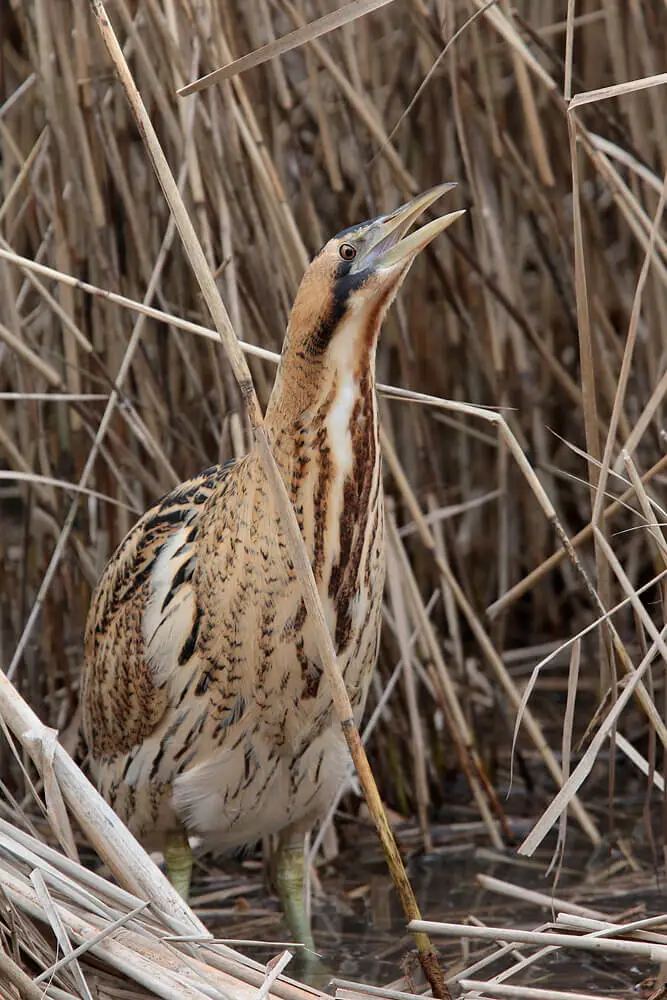
This heron lives in freshwater or brackish marshes with large areas of reed beds. It needs flooded reed beds with sufficient water levels to protect its nest from predators.
Its diet consists mainly of fish, amphibians, and aquatic insects, which it hunts discreetly. It moves slowly, lying in wait, its neck tucked into its shoulders. When prey comes within range, it extends its long neck to catch or pierce its target with its beak, which acts like a spear. In addition to being a formidable weapon, its long neck also allows the bittern to camouflage itself in the reeds. When it feels threatened, it extends its neck, aided by plumage that resembles the colors of the reed bed, blending completely into the surrounding vegetation. It can remain like this for several hours, waiting for the danger to pass, even moving its neck to mimic the movement of the wind in the reeds. This makes it difficult to detect its presence in an area.
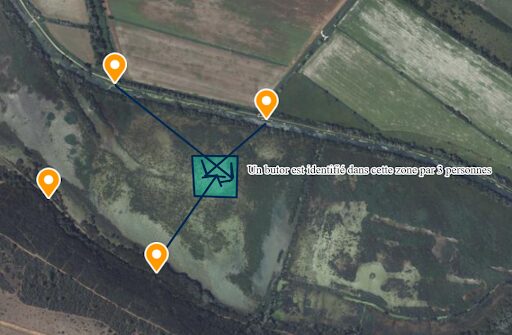
However, there are various techniques for achieving this. One of them involves covering an area with a team positioned at different listening points at dusk or dawn (the time of day when the male bittern sings most often) during the breeding season (April-May). With the help of a map, each participant will draw an arrow representing the direction from which the song came and the corresponding time. At the end of the listening session, the maps will be pooled to validate and precisely locate the different singing bitterns.
It is thanks to this technique that we were able to identify a male singer in the Ilon Regional Nature Reserve several times this spring.
As this species is polygamous, it is likely that there are also several females on the site (up to five).
This is exciting news, as it is the first male identified in over thirty years! But also because the species is protected and critically endangered in France, with fewer than 300 singing males recorded in 2018 and a continuing downward trend.
Its return to the marshes of Les Baux is therefore encouraging news, suggesting that water levels and habitats are favorable for nesting.